How to Send Large Files Without Compressing Using GoodSend
Overview
Sending large files without compression is easy with GoodSend. When you need to maintain the original quality and format of your files - such as high-resolution videos, design files, or detailed presentations - GoodSend allows you to transfer files up to 10GB without any compression or quality loss.
Here's the part most guides skip: for the big files you actually send, compressing them first is usually pointless. Video, photos, and music are already compressed formats — zipping them shrinks them by a percent or two at best. You spend ten minutes creating an archive, your recipient spends another five unpacking it, and the file is effectively the same size it was. The faster path is to just upload the original.
Most Large Files Are Already Compressed
The files that are big enough to cause problems — video, photos, audio — are big despite already being heavily compressed. An MP4 is H.264 or H.265 compressed video. A JPG is compressed photography. An MP3 is compressed audio. Compression algorithms can't meaningfully squeeze data that has already been squeezed, so zipping these formats achieves almost nothing:
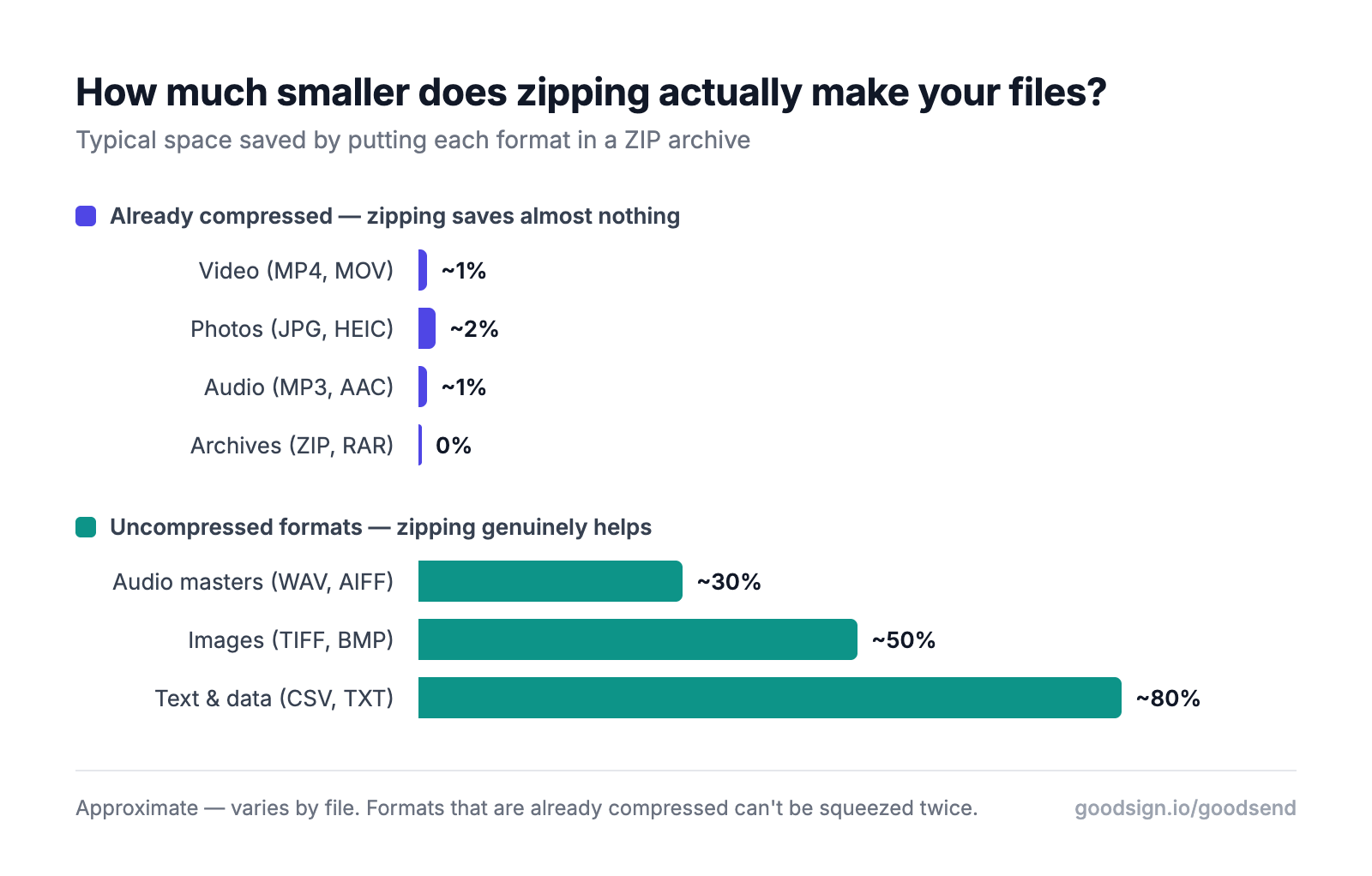
Zipping genuinely helps for uncompressed formats — WAV masters, TIFF scans, big CSV exports. But if you're sending a 2GB wedding video, a folder of JPGs, or a finished podcast, the zip step costs you time and saves you nothing. Worse, some recipients on phones and tablets struggle to open archives at all.
Compression Won't Fix the Email Problem Anyway
The usual reason people compress files is to squeeze them under an email attachment limit — Gmail caps attachments at 25MB, Outlook at 20MB. But compression can't get a 2GB video under 25MB; no algorithm can. Once a file is bigger than a few dozen megabytes, you need a transfer link either way, so the zip step solves nothing. A transfer service like GoodSend sends your recipient a download link instead of an attachment, which is exactly what the situation calls for.
Why Send Without Compression?
Compressing files can sometimes result in quality degradation or format compatibility issues. Common scenarios where uncompressed transfers are preferred include:
- Professional video files where every pixel matters
- Design assets that require precise color accuracy
- Medical or technical images requiring full resolution
- Legal documents that must maintain original formatting
- Audio files where sound quality is critical
Step-by-Step Guide to Sending Uncompressed Files
1. Prepare Your Files
- Ensure your files are ready for transfer (up to 20 files per send)
- Each file can be up to 5GB, with a 10GB total per transfer
- No need to compress - GoodSend handles large files in their original format
2. Upload Your Files to GoodSend
- Go to GoodSend
- Choose your upload method:
- Drag and drop files directly onto the upload area
- Click the upload area to browse and select files from your device
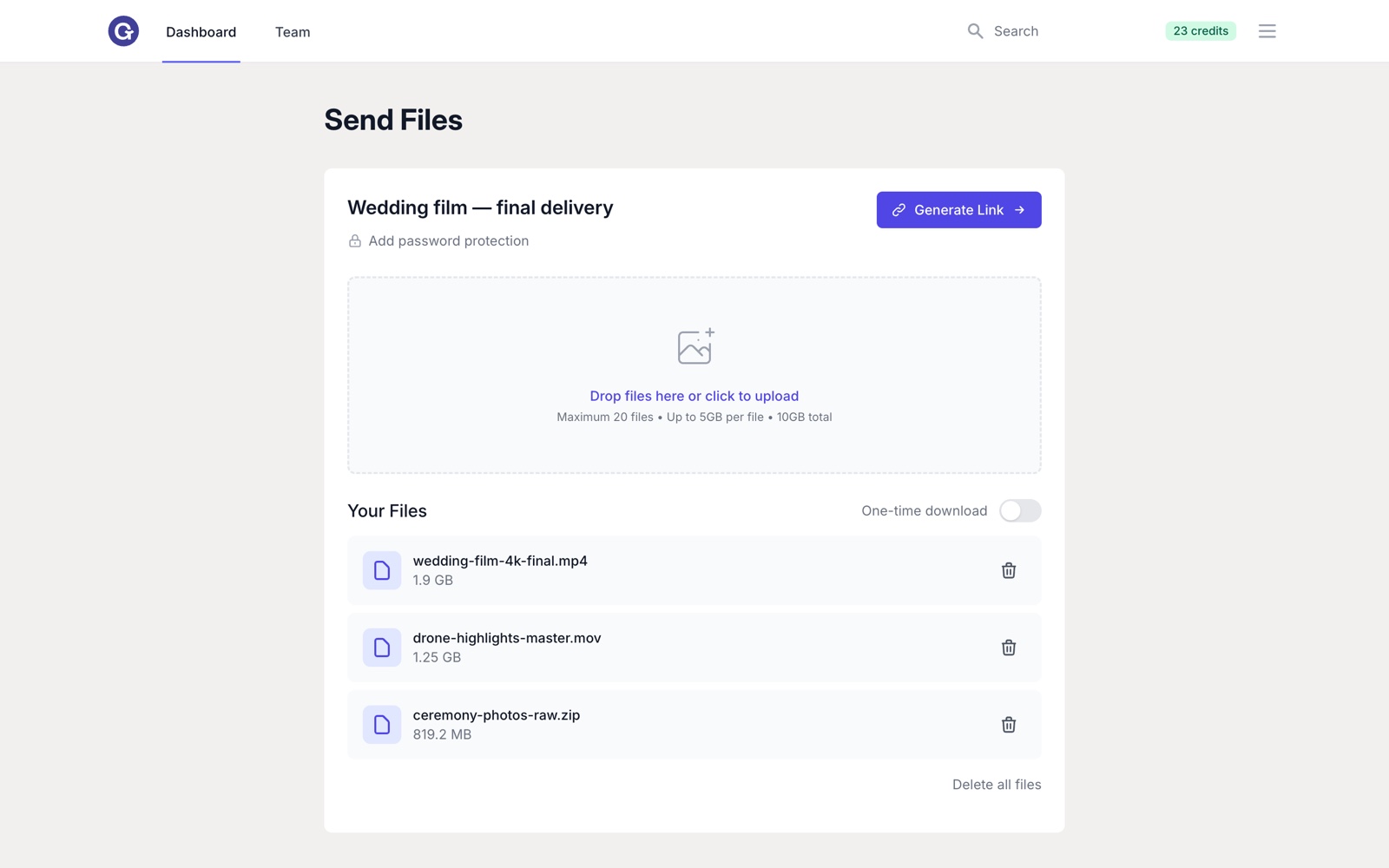
That's the whole job — no archiving step, no splitting files to fit a limit. Here's a real transfer with almost 4GB of video queued exactly as the files came off the camera:
3. Generate Your Link
- Click "Generate Link" to create the secure transfer
- Each send costs 1 credit ($1.50) — if this is your first send, you'll be prompted to purchase credits
- Minimum purchase is 10 credits ($15.00)
- Payment is processed securely through Stripe
4. Share or Email the Transfer
- Copy the share link and send it however you like, or
- Enter the recipient's name and email address and GoodSend delivers it for you
- You can send to multiple recipients by adding additional email addresses
5. Track Your Transfer
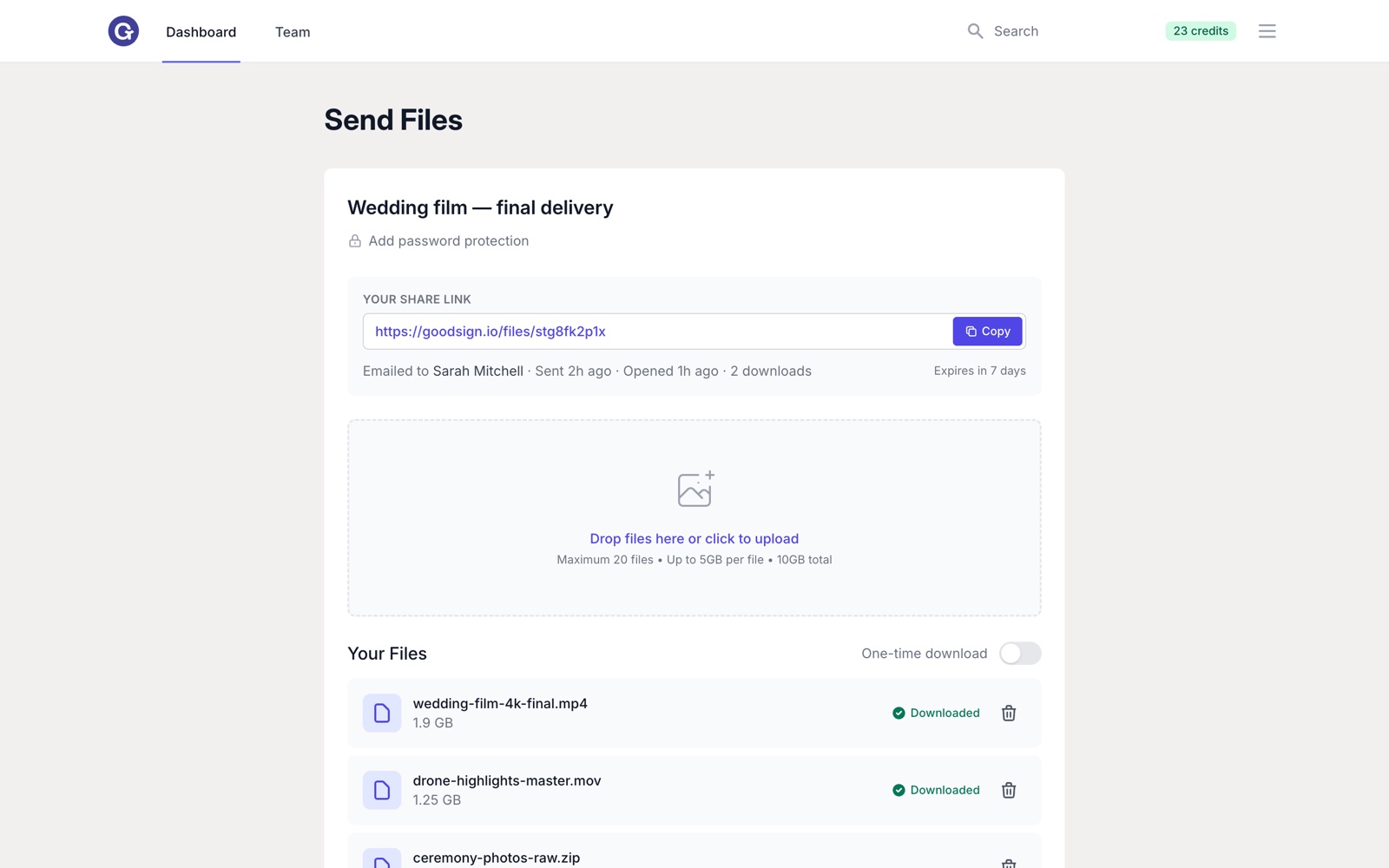
After sending, you can monitor the status of your transfer:
- Track when the email is delivered
- See when the recipient opens the email
- Confirm when files are downloaded
How Long Does the Upload Take?
Upload time depends on your internet connection, not on GoodSend — and it's almost always faster than compress-then-upload, because the zip step adds minutes and removes almost nothing:
| Your upload speed | 2GB transfer | 10GB transfer |
|---|---|---|
| 20 Mbps | ~13 minutes | ~67 minutes |
| 50 Mbps | ~5 minutes | ~27 minutes |
| 100 Mbps | ~3 minutes | ~13 minutes |
| 250 Mbps | ~1 minute | ~5 minutes |
Compressing a 2GB video first might take 10-20 minutes of CPU time to save around 1% of the upload — you'd finish later than if you'd simply started the upload straight away.
File Type Support
GoodSend supports all file types, including but not limited to:
| File Category | Examples |
|---|---|
| Video | MP4, MOV, AVI, ProRes |
| Images | RAW, TIF, PSD, JPG, PNG |
| Documents | PDF, DOCX, XLSX, PPTX |
| Design | AI, INDD, XD, Sketch |
| Audio | WAV, AIFF, MP3, FLAC |
| Archives | ZIP, RAR (no need to create these yourself) |
Important Notes About File Transfers
- Files automatically expire and are deleted after 7 days
- Recipients receive a secure link via email to download the files
- No account is required for recipients to download files
- The service maintains end-to-end encryption for security
- No file compression occurs during the transfer process
Troubleshooting Tips
Issue: Upload seems slow Solution: Check your internet connection speed. Larger files naturally take longer to upload.
Issue: Recipient claims they didn't receive the file Solution: Check the tracking information to confirm delivery status. If needed, resend the files.
Issue: File size exceeds 10GB limit Solution: Consider sending files in multiple batches instead of compressing.
Issue: Credit card payment not processing Solution: Ensure your card details are correct and try again, or use a different card.
Quick Tips
- Save time: Prepare all files in a single folder before uploading
- Ensure delivery: Double-check recipient email addresses for accuracy
- Improve security: Let recipients know to expect the file transfer
- Track efficiently: Keep the confirmation email for easy access to tracking
- Credit management: Purchase credits in bulk to have them ready for urgent transfers
- File organization: Give files clear names before uploading to avoid confusion
- Expiration awareness: Remind recipients that links expire after 7 days