Witness Signing Online: What's Legal, What's Required, and How to Do It Right
Most people assume a witness just watches you sign. In law, a witness does considerably more — and getting it wrong can invalidate the entire document. If you're dealing with a will, a deed, or a statutory declaration, understanding legal witness electronic signature requirements isn't optional. It's the difference between a binding document and an expensive problem.
GoodSign's witness signing feature handles this process correctly, and this article explains exactly what that means in practice.
Witness signature: the short version
- What it is. An independent adult watches you sign, then signs the document themselves to confirm who you are and that you signed willingly.
- Who can be a witness. Someone over 18 who is not a party to the document and has nothing to gain from it. Wills, powers of attorney and statutory declarations often need a qualified witness such as a JP, solicitor or notary.
- The rules that matter. The witness must actually observe the signing, sign after the signer, and complete the witness block with their name and usually their address and occupation.
- Doing it electronically. The same three rules apply. The signer signs first, the witness is invited second, and the audit trail proves the order. GoodSign's witness signing enforces that sequence for one extra credit per witness.
The rest of this article covers each of those points in detail.
What a Legal Witness Actually Does
A witness serves a specific legal function: they confirm the identity of the signer, observe the signing act, and then sign the document themselves to attest to both. This isn't ceremonial. Courts rely on witness signatures as independent verification that a document was signed voluntarily, by the right person, at the stated time.
This is why witness identity matters as much as signer identity. A witness can't be the other party to the agreement. In many jurisdictions, they can't be a family member of the signer. They must be an independent adult who genuinely observed the signing — not someone who signed afterward on a colleague's say-so.
When You Actually Need a Witness
Not every document requires one. Standard contracts, NDAs, and most business agreements don't. But several document types almost universally require witnessed signatures, and skipping the step renders them void.
- Wills and testaments — most jurisdictions require two independent witnesses who observe the testator sign, then sign themselves in each other's presence
- Property deeds and land transfers — a deed executed without a proper witness is typically unenforceable in conveyancing
- Statutory declarations and affidavits — witnessing here often must be performed by a qualified person (JP, solicitor, notary) rather than any adult
- Powers of attorney — particularly enduring or lasting powers, which carry strict witnessing rules
- Service agreements in regulated sectors — for example, some NDIS service agreements are witnessed as a safeguard even where the law doesn't strictly demand it
The legal threshold for adding a witness to a document varies by document type and jurisdiction, but the underlying logic is consistent: someone independent must verify the signing happened correctly.
Why Sequential Signing Order Is the Whole Point
Here's where many digital workflows break down. If the signer and witness both receive the document simultaneously and sign in any order they like, the process fails the legal test. The witness is supposed to observe the signing. If the witness signs first, or if both sign simultaneously without any confirmed sequence, there's no valid attestation.
Sequential signing isn't a feature preference — it's a legal requirement.
A proper electronic witness signing workflow must enforce this order: the primary signer receives the document and completes their signature first. Only after that action is confirmed does the witness receive notification to sign. This sequencing mirrors what happens in a physical room and satisfies the legal standard that witnessing is supposed to represent.
How GoodSign's Witness Signing Works
GoodSign enforces this correctly. When you set up a document with a witness, you define both signers and their order before sending. The system holds the witness notification until the primary signer has completed their signature — the witness cannot jump ahead.
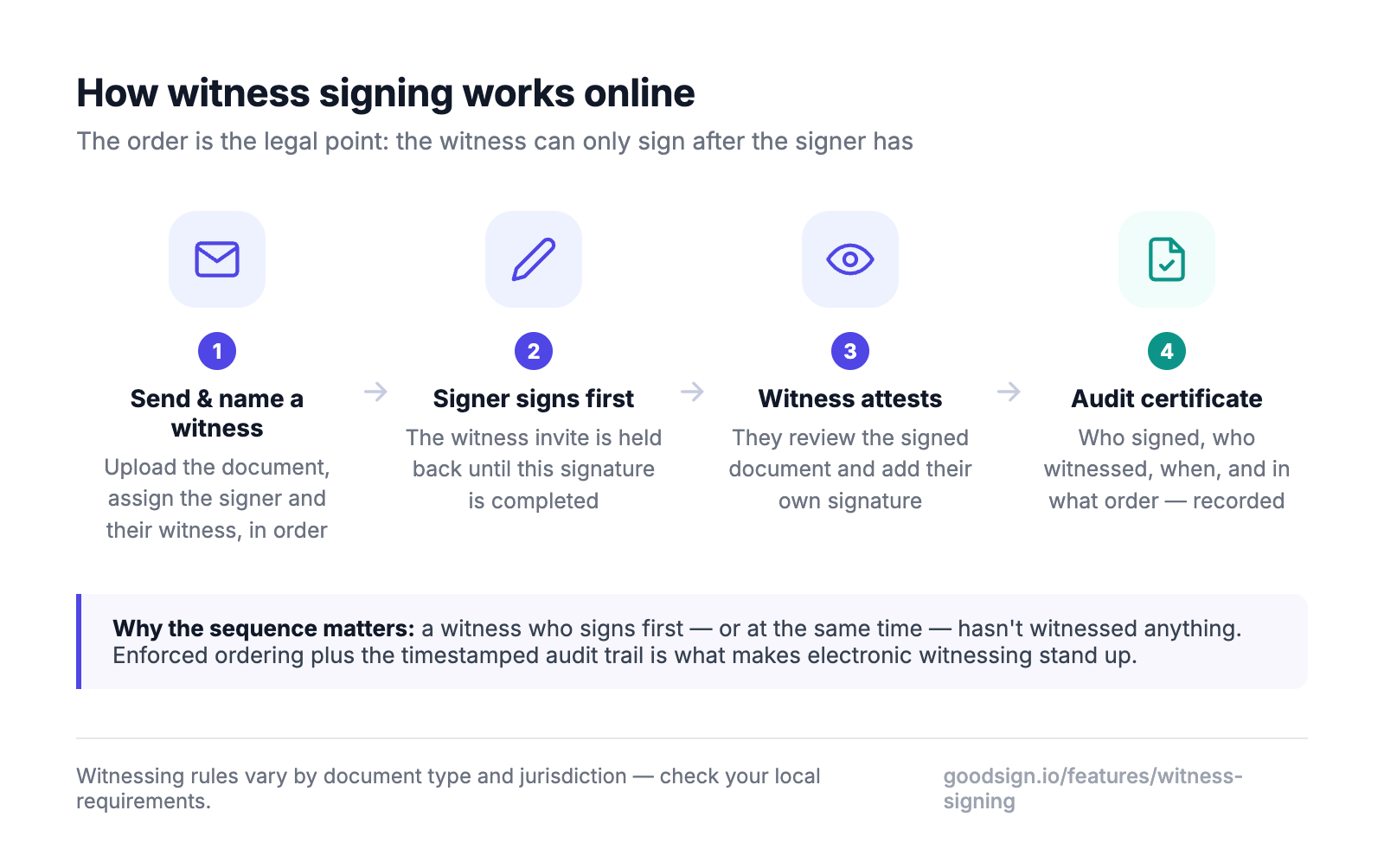
Here's what the process looks like in practice:
- You upload the document and assign the primary signer and witness roles, specifying the witness receives the document second
- The primary signer gets a notification, opens the document, completes their signature, and submits
- GoodSign then automatically notifies the witness that it's their turn
- The witness reviews the signed document — including the primary signer's completed signature — and adds their own
- Both parties receive a finalised, countersigned document
The automatic signer notification at each stage removes the manual coordination that causes errors in ad hoc email-based workflows. There's no chasing, no guessing whether someone has signed yet, and no risk of the witness signing on a blank document.
The Audit Trail as Proof of Witness Identity
This is where electronic witnessing has a measurable advantage over paper. When you add a witness to a document through GoodSign, every action is logged in a tamper-evident audit trail: who opened the document, when they opened it, what IP address they used, when they signed, and in what sequence.
The audit trail is your proof of witness identity and process compliance. If a document is ever challenged, you're not relying on memory or a signature that could be anyone's. You have a timestamped record showing the witness received the document after the primary signer completed theirs, confirming the sequencing that makes the witnessing legally valid.
For documents like property deeds or contested wills, this level of evidence is precisely what a court asks for — and it's generated automatically, on every witnessed send, without anyone having to remember to keep records.
What Witness Signing Costs — Here and Elsewhere
Witness signing is one of the clearest examples of a feature the big platforms reserve for their top tiers.
On DocuSign, the eWitness feature is not available on the Personal or Standard plans — it requires Business Pro, from around US$40 per user per month billed annually, or their IAM Professional tier. Adobe gates its e-Witness recipient role to Acrobat Sign's enterprise-level service — it isn't part of the individual or small-team Acrobat plans. In both cases you pay the subscription whether you witness one document a year or a hundred.
GoodSign prices it per document instead: a witnessed document costs 2 credits — US$3 total ($1.50 for the envelope plus $1.50 for the witness). No plan upgrade, no per-seat maths, no paying in the months you don't use it.
Real numbers: one GoodSign customer has spent about US$100 in total on witnessed signings — that's over 30 fully witnessed, audit-trailed documents. On a platform that gates witnessing behind a ~US$40/user/month tier, US$100 buys roughly ten weeks of subscription for a single seat — before a single document goes out.
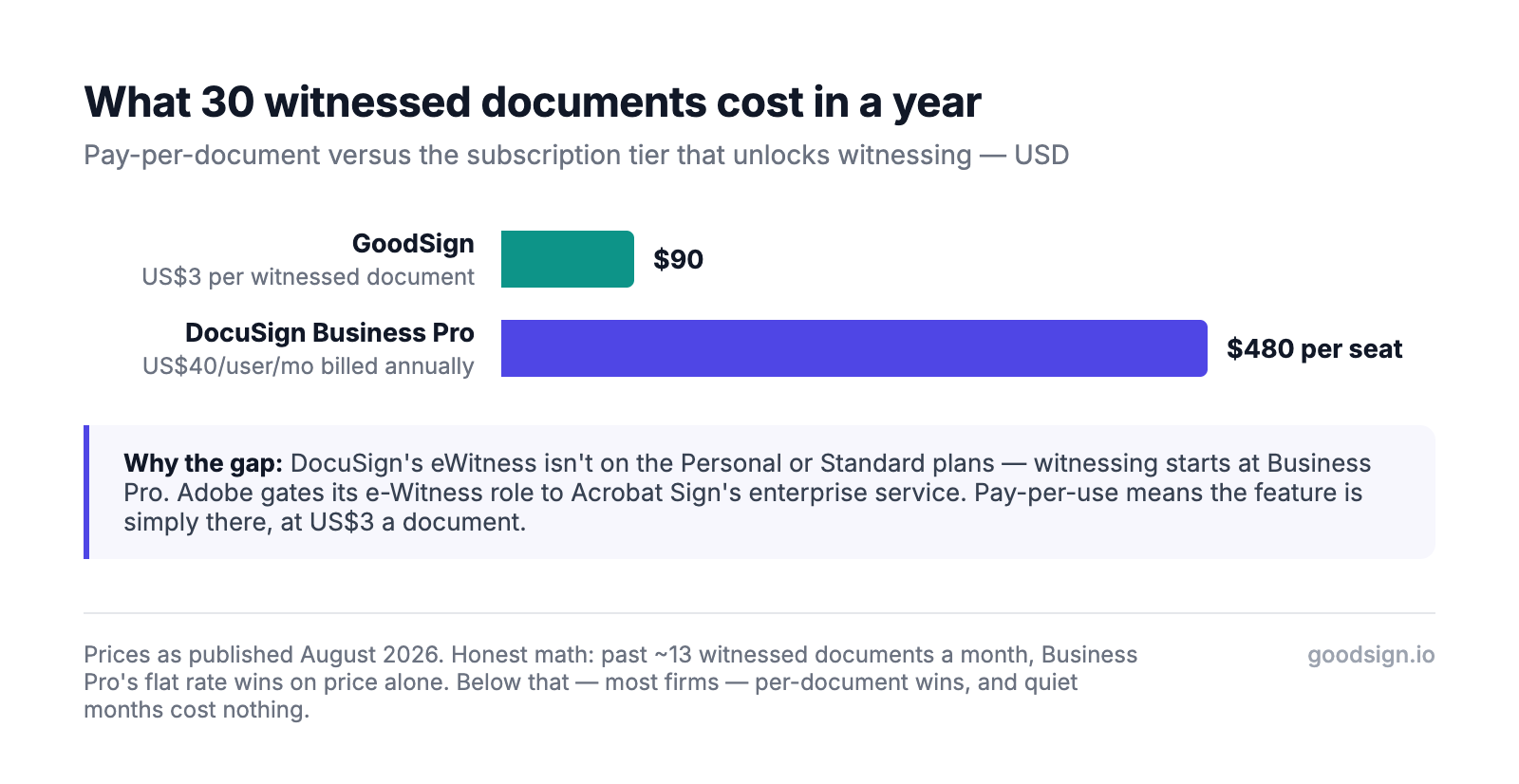
If witnessed documents are your everyday volume, a subscription can still make sense. If they're occasional — a deed this month, a statutory declaration next quarter — paying US$3 when it happens is hard to beat. Full pricing is on the pricing page.
Witness Signing FAQ
Can a family member witness a signature?
Often no, and it's rarely worth the risk even where it's technically allowed. Many jurisdictions require witnesses to be independent — not a party to the document, not a beneficiary, and in stricter cases (wills, powers of attorney) not a spouse or relative of the signer. If the document matters enough to witness, choose an independent adult with nothing to gain from it. Rules vary by jurisdiction and document type, so check your local requirements.
Who can be a witness on a legal document?
The baseline in most places: an adult of sound mind who is independent of the transaction, physically or procedurally able to observe the signing, and willing to sign an attestation. Some documents raise the bar to a qualified witness — a justice of the peace, solicitor, or notary — particularly for statutory declarations and affidavits.
What does the witness section of a document actually say?
The witness block — often headed "as witnessed by" or "in the presence of" — typically records the witness's signature, full name, and sometimes their address and occupation. Its function is to attach a verifiable, independent person to the attestation. In GoodSign, the witness's details and signature are captured in their own signing step and recorded on the audit certificate.
Do bank documents need a witness?
Some do. Guarantees, certain mortgage documents, and deeds connected to lending commonly require witnessed execution, and banks may impose witnessing requirements beyond the legal minimum. The bank's own execution instructions are the authority here — if they specify a witness, the document needs one regardless of what statute says.
Can witnessing be done online?
Yes, in a growing number of jurisdictions — with conditions. The workflow must preserve what witnessing is for: the witness genuinely observing the signing and attesting afterwards, in the right order. That's exactly what a sequenced electronic workflow with an audit trail provides. Some documents in some jurisdictions still require physical presence or a qualified witness, so verify the rules for your specific document. For how the electronic version works step by step, including a remote witness signature from the witness's own device, see witness signing in GoodSign.
How do I add a witness on DocuSign — and is there a cheaper way?
DocuSign's eWitness handles witnessed signing, but only on Business Pro and above. If you're on a lower tier — or don't want a subscription at all — GoodSign's witness signing does the same sequenced, audit-trailed workflow for US$3 per witnessed document, with no plan requirement.
Getting Witness Signing Right
The mechanics matter: right witness, right order, right records. Get those three correct and an electronically witnessed document is not just as good as paper — its audit trail makes it easier to defend. Set up a witnessed send in a couple of minutes at goodsign.io/features/witness-signing, and pay only when you use it.
Witnessing requirements differ by jurisdiction and document type. This article is general information, not legal advice — for high-stakes documents, confirm requirements with a qualified professional in your jurisdiction.
Need documents signed? Start with a free electronic signature account — no subscription, $1.50 per envelope.